
DevTools Brew #7: How Technical Founders Learn Enterprise Sales, How We Lost 54k GitHub Stars, GitHub Accelerator: The First Cohort...

Welcome to the DevTools Brew #7!
My name is Morgan Perry, co-founder of Qovery, and this is DevTools Brew newsletter, a weekly roundup of the latest trends and insights in the infrastructure and devtools industry.
To receive it in your inbox each week, subscribe here!
In this Issue #7:
💸 Latest Devtools Funding Rounds
📈 How Technical Founders Learn Enterprise Sales
💻 How We Lost 54k GitHub Stars
⭐ Star History Weekly Pick
🔮 GitHub Accelerator: The First Cohort
I hope you will enjoy this sneak peek.
Let's dive in!
💸 Latest Funding Rounds
Semgrep (formerly r2c) announced it has raised a $53M Series C to grow code security platform
Qdrant, an open source database startup that helps AI developers leverage unstructured data just announced a $7.5M seed financing
CoreWeave announced a $221M Series B to Expand Specialized Cloud Infrastructure Powering the Generative AI and Large Language Model Boom
📈 How Technical Founders Learn Enterprise Sales
6 Leading Tech Founders Describe Their First Enterprise Win
This article from EssenceVC is about the challenges that technical founders face when selling to Fortune 500 customers.
Six leading Tech founders were interviewed to understand their approach to their first enterprise sale and how it can help early-stage technical founders.
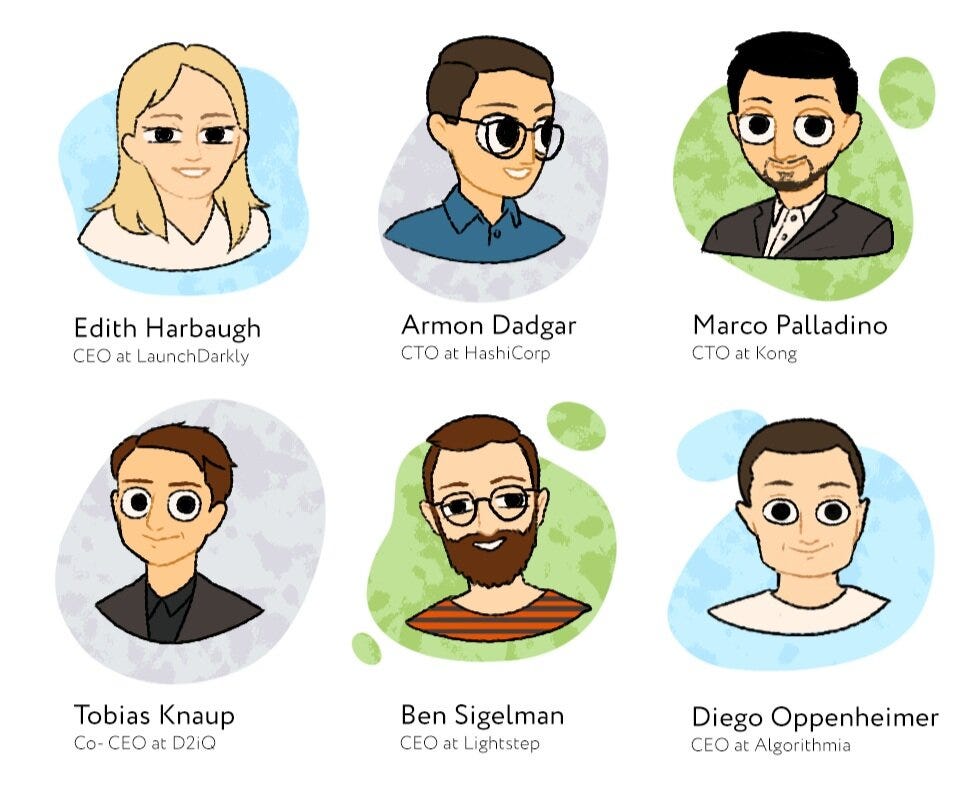
12 Key Learnings:
To set context, the first paying enterprise customer (at least $10K annual contract value, but at times up to $100K) for these devtools/infrastrucutre companies typically came 1-2 years into the company’s life, around the time of their Series A.
Some were not enterprise focused to start - HashiCorp, Kong, and LaunchDarkly used bottoms-up sales models before their first enterprise deal. Once demand from larger accounts was clear, they developed enterprise go-to-market motions to meet that demand.
Learning 1: “Know Your Customer Profile”
At HashiCorp, go-to-market was initially designed for SMBs, but once the opportunity in the enterprise became clear, they reframed their pricing, positioning, and sales motion to successfully go after that segment.
At Lightstep, early adopters were “hipster” tech companies. These were fast-growing mid to late stage startups with forward-thinking engineers that had a budget and could move quickly. Their go-to-market motion was tailored to these types of companies.
At Kong, they focused on companies making the transition to microservices. They did not try to sell the concept of microservices to companies not yet interested in building that way.
Learning 2: Founders Should Own Early Sales
At HashiCorp, the CTO Armon Dadgar flew to Australia to train their first enterprise customer.
At LaunchDarkly, they did not hire a salesperson until they passed $500K in sales. They believed founders needed to understand the buyer and their needs and convey those back to the engineering team when the company was early in its journey.
At Kong and Algorithmia, the founders acted as initial sales engineers working directly with prospects to close early deals.
Learning 3: Make The Architect Successful; The User is Your Internal Champion
The architect will have a lot of sway in the decision to buy.
When selling DevOps products to enterprise companies, multiple personas including the economic buyer (VP Engineering/Infrastructure), legal, procurement, and security, as well as the architect (or engineer), who holds significant influence, must approve the sale..
At Lightstep, the architect was involved in testing the technology, as well as negotiating the terms of the contract.
At Kong, the team had a Slack channel during the proof-of-concept (POC) phase that was supported 24 hours a day to make sure the architects were happy.
At D2iQ, the architect would be the key sign-off on whether roadmap features were satisfactory to translate the POC into a closed deal.
Learning 4: Price with Procurement in Mind
Once the key stakeholders approve the purchase, the procurement team (often part of finance or operations) will review the contract structure, pricing, and proposed ROI, and attempt to negotiate a lower price
At LaunchDarkly, initial pricing was based on events (a usage-based metric). That ended up being a difficult metric for finance and procurement to understand. Due to that feedback, LaunchDarkly moved to per-seat pricing.
Learning 5: Be Prepared for Bespoke Requests
It's essential to prioritize investments and say 'no' wisely
When selling to a large enterprise, accommodating customer feature requests is crucial, but it's important to balance being customer-centric without becoming a service provider. With limited resources, it's essential to prioritize investments and say 'no' wisely.
At Kong, their first enterprise customer would only buy if they had a developer portal. In order to get the deal over the line, Kong acquired a small company out of New Zealand that had a portal called Gelato.io. They knew other enterprise customers would want that functionality so there would be enough value generated over time to justify the acquisition.
Learning 6: Run in Production Environments Early if That is Where ROI Will Be Demonstrated
Make it easy to get to production fast.
If your technology will demonstrate more value to the customer by running in a production rather than a POC environment, make it easy to get to production fast.
At Lightstep, contracts were fully cancellable for the first 2-3 months. This made it easy for procurement to sign off on deals and move Lightstep’s technology to production quickly.
Learning 7: Put Together a Closing Plan
A closing plan, a document outlining the steps and timeline to a signed contract, including stakeholders, champions, and potential blockers, is crucial for well-trained sales executives and managers. Keeping all customer-side stakeholders informed about the plan's status during the sales process is equally important
When Algorithmia was going through their first enterprise deal process, they underestimated the time it would take to close the sale and the number of stakeholders involved.
Learning 8: Don’t Underestimate the Human Element of Sales
People buy from people
At Kong, the team was super high-touch with customers. They had a wartime salesperson who was relentless at making customers successful and because of that was able to close their first $2M of total contract value during the first 6 months the company was in market.
At HashiCorp, their first enterprise deal process taught them how relationship-driven upmarket sales are. It’s why the CTO Armon Dadgar flew to Australia to meet with their first customer in person.
Learning 9: Time to “wow” Matters
Making it easy for customers to quickly see value in the product makes the sales process a lot easier
At Kong, the product was simple to adopt and you did not need to learn the entire platform to start using it or seeing value from it.
At D2iQ, the full version of their product took time to get set up so they put out a free version called “Elastic Mesos” that customers could spin up in under 15 minutes.
Learning 10: Add Enterprise Features Early On
To avoid repeating work on enterprise customer security questionnaires, our founders would get SOC 2 certifications early. Further, enterprise customers often want standard “enterprise features” like single sign on (SSO) integrations so it’s good to invest in those early.
Learning 11: Have a High Quality “About Us” Page on Your Website
Enterprise customers that buy from small startups are taking a lot of risk. An easy way to gain credibility is investing in a thoughtful “about us” page that highlights who the team is and their credentials.
Learning 12: ROI Matters Today More Than Ever
Budgets are constrained, even for software infrastructure, so products that can clearly demonstrate ROI through cutting costs or performing a function more efficiently or effectively are ones that will be able to get deals signed.
—> Check out the full article published by EssenceVC.
💻 How We Lost 54k GitHub Stars
Do you know the crazy story of HTTPie, an open-source CLI HTTP client that lost 54k GitHub stars?!!

The founder of HTTPie shared insights about the unfortunate events that led to the accidental deletion of a 10-year-old community, built with hard work and passion.
—> Read the full article on to discover how a simple mistake can have dramatic consequences and what lessons we can learn from this experience.
/!\ This is not an isolated story, we, at Qovery, have also experienced the same tragedy in late 2021. We shared this sad story on “We lost 3800 stars on Github in 1 click 😭”
⭐ Star History Weekly Pick
The Star History Weekly Pick is:
Tabby: “Self-hosted AI coding assistant”
⭐️ 5.7k stars reached

🔮 GitHub Accelerator: The First Cohort
GitHub Accelerator is a 10-week program where open source maintainers receive an initial sponsorship of $20K to work on their project.
This 2023 cohort has 20 projects, with 32 participants from all over the world.
Meet the 20 projects in GitHub Accelerator:
analogjs/analog: Analog is a fullstack meta-framework to build applications and websites with Angular.
Atri-Labs/atrilabs-engine: The Python web framework to build production-grade apps.
bigskysoftware/htmx: Makes AJAX, Web Sockets, etc. available directly in HTML.
code-hike/codehike: Tools for building all types of code walkthroughs: blogs, docs, slides, tutorials, etc.
DioxusLabs/dioxus: Friendly React-like GUI library for desktop, web, mobile, and more, written in Rust.
EddieHubCommunity/LinkFree: Connecting with your audience with a single link, showcasing your content and projects.
FashionFreedom/Seamly2D: Design CAD to democratize and de-centralize fashion design & production.
fastai/nbdev: Increase developer productivity by 10x with a new exploratory programming workflow.
formbricks/formbricks: We’re building all essential form functionality. Modular, customizable & extendable.
GyulyVGC/sniffnet: Cross-platform application to comfortably monitor and analyse network traffic.
JessicaTegner/pypandoc: Pypandoc provides a thin wrapper for pandoc, a universal document converter.
mockoon/mockoon: Mockoon is the easiest and quickest way to design and run mock REST APIs.
nuxt/nuxt: An intuitive framework for building web applications, built for the edge.
responsively-org/responsively-app: A dev-tool for web developers that aid in faster responsive web page development.
simonw/datasette: An open source multi-tool for exploring and publishing data.
spyder-ide/spyder: The scientific Python development environment.
strawberry-graphql/strawberry: A GraphQL library for Python that leverages type annotations.
termux/termux-app: A terminal emulator for Android that provides 2000+ linux packages to code on phone.
TimothyStiles/poly: Poly is a fast, well tested Go package for engineering organisms.
trpc/trpc: End-to-end typesafe APIs made easy. Never write another API contract again.
It’s already over! If you have any comments or feedback, Let’s talk about this together on LinkedIn or on Twitter.
Thanks for reading,
Morgan
Please share DevTools Brew with your friends, and subscribe